
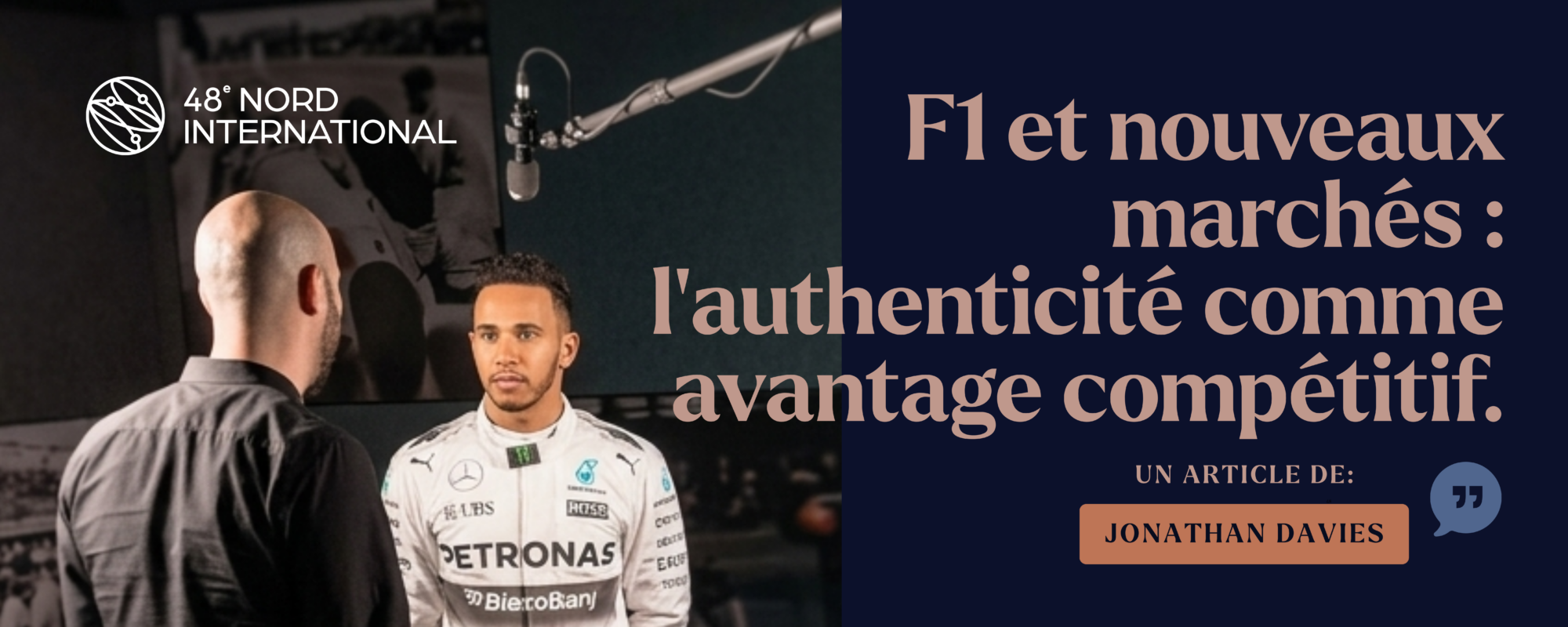
In 2014, I made a decision that could have cost my company its biggest client.
We were working with Mercedes AMG Petronas, a Formula 1 team with a prestigious name but not much to show for it yet. Not yet, anyway. I had to interview their two drivers, Lewis Hamilton and Nico Rosberg, about that year’s technical regulation changes: front wing flex limits. A new panel, officially called a “modesty plate,” designed purely to hide an ugly car nose the regulations had accidentally created. Thirty minutes per driver, one interview setup, no time for fancy graphics in post. Not much room to work with.
I also knew every other team would be covering the same changes. Almost certainly in a stiff, conventional way. We’d all end up producing the same content, distinguishable only by the color of the race suits.
So my team and I had an idea. What if Hamilton and Rosberg, a few days before the season started, pretended they had no idea the rules had changed at all? Total confusion. A full parody of the interview format.
Now, it’s worth noting that F1 drivers like exactly three things: racing, more racing, and not doing interviews. The topic bored me. Interviews bore them. It seemed like a perfect match. It also seemed like the kind of pitch that would get me thrown off the track rather than invited back to the podium.
The drivers arrived, already politely unimpressed. I pitched them the idea.
There’s a particular kind of silence that settles in when two world-class athletes are deciding whether you’re interesting or whether you’ve just wasted their afternoon. It lasted about three seconds. Then Hamilton burst out laughing. Rosberg followed. We shot the scene in one take: two of the best drivers on the planet pretending to be completely blindsided by their own sport.
The video aired. News channels around the world picked up the joke, and within days it had gone around the globe. Not because of the regulation changes. Because two drivers stopped being brand assets and started being themselves.
As much as I’d love to give my team and me a big pat on the back for that campaign (and marketers do love patting ourselves on the back), what we proposed wasn’t revolutionary or clever. We just dropped the pretense and said what we actually thought would work. We noticed two genuinely funny people trapped in a boring format, and we gave them room to be funny.
The most important laugh in that room wasn’t Hamilton’s. It was the client’s. Mercedes got it immediately. We worked together for many years after that.
That’s what authenticity actually is. The real version doesn’t announce itself. It just shows up once you stop playing a role and start being honest about what you actually are.
The problem is that most companies do the opposite.
Coco Chanel, the French designer who built one of the most enduring fashion houses in history, once said, “Hard times arouse an instinctive desire for authenticity.” That explains exactly why every company is rushing toward that word right now. Economic uncertainty, the flood of AI-generated content that all looks the same. People want something real. So brands are using that word more and more, while drifting further and further from it.
Zig Ziglar, the American sales trainer whose books shaped a whole generation of salespeople, described this mechanism better than most marketing textbooks ever have: “If people like you, they’ll listen to you. If they trust you, they’ll do business with you.”
Most companies work hard to be “liked.” Catchy taglines, a friendly tone, a value proposition featured on their website. Trust, on the other hand, is a different thing, and a harder one to earn. Trust comes from proof, not adjectives.
That matters more in industrial and technical sectors than almost anywhere else. According to a study by Shanahan Strategy, a firm specializing in industrial marketing, 77% of B2B buyers in the evaluation stage say case studies influence them more than any other type of content. Not brand stories. Not value statements. Documented proof that someone like them solved a problem similar to theirs.
Companies in mining, manufacturing, and industrial technology have concrete material that most consumer brands can only dream of: family businesses passed down through generations, real environmental stakes, real economic impact on small towns and regional economies. The substance is already there.
The mistake is choosing words over proof. Saying “authentic” instead of showing what makes that true.
Whether you’re pitching a client or entering a new market, trying to figure out how to stand out can pull you into a vicious circle. You end up with a generic message, inauthentic positioning, and a value proposition that could apply to anyone. If you find yourself there, stop. Step back. Look for what’s already true about what you do, and what you can actually prove about it.
That’s usually where the real story is.
Find it. Then get out of its way.
Curious how two of the best drivers in the world reacted when we asked them to drop their media training and just be themselves? You can watch it here: